
Who pays when a pipe leaks? - Estate Plumbing Leak Detection Liability
Short answer: the owner of the damaged pipe pays for the repair, while whoever holds the eThekwini account pays for the water lost. In schemes, that account holder is often the body corporate or homeowners' association (HOA). For professional residential and commercial leak detection in Durban, contact AquaFix for assistance in identifying and locating hidden leaks.
- Sectional title: the body corporate fixes common property and shared pipes; owners fix pipes serving only their section.
- Hot water: owners maintain and repair the geyser installation serving their section, even where it sits on common property.
- HOA estates: your Memorandum of Incorporation (MOI) and metering model decide. Private pipework behind a bulk meter is normally the estate's problem.
- Billing: eThekwini bills what the meter records, leak or not.
Who is liable for a leak in a Durban sectional title scheme?
Liability follows ownership: the body corporate answers for common property, and each owner answers for their own section. The Sectional Titles Schemes Management Act (STSMA) sets that split through its body corporate functions and owner duties provisions, and your sectional plan shows where the line falls.
- Shared pipes: the body corporate repairs common property and any pipe serving more than one section, funded from levies.
- Single-section pipes: owners repair pipes that form part of, and serve only, their section.
- Hot water: Prescribed Management Rule 31 makes owners maintain, repair and replace the water-heating installation serving their section, even if it is common property insured by the body corporate.
- Neighbour damage: the party that is responsible for the leaking pipe can face a claim for reasonable repair costs. Owners hit by a common property leak claim from the body corporate.
Who pays for leaks in a Durban homeowners’ association estate?
It depends on who owns the pipework behind the municipal meter, and your estate's governing documents decide that. Many estates receive bulk water through one metered point, after which responsibility for reticulation (the internal pipe network) passes to estate management. Your MOI and conduct rules then will determine who maintains what.
- Estate-owned pipework: the HOA repairs leaks in common reticulation behind the bulk meter, funded by levies.
- Individual eThekwini meters: where each home has its own meter, eThekwini says a leak inside your boundary may be your responsibility.
- Private sub-meters (estate-owned meters measuring each home's use): a leak before the meter usually hits the HOA; after it, the homeowner.
How does eThekwini billing affect leak liability?
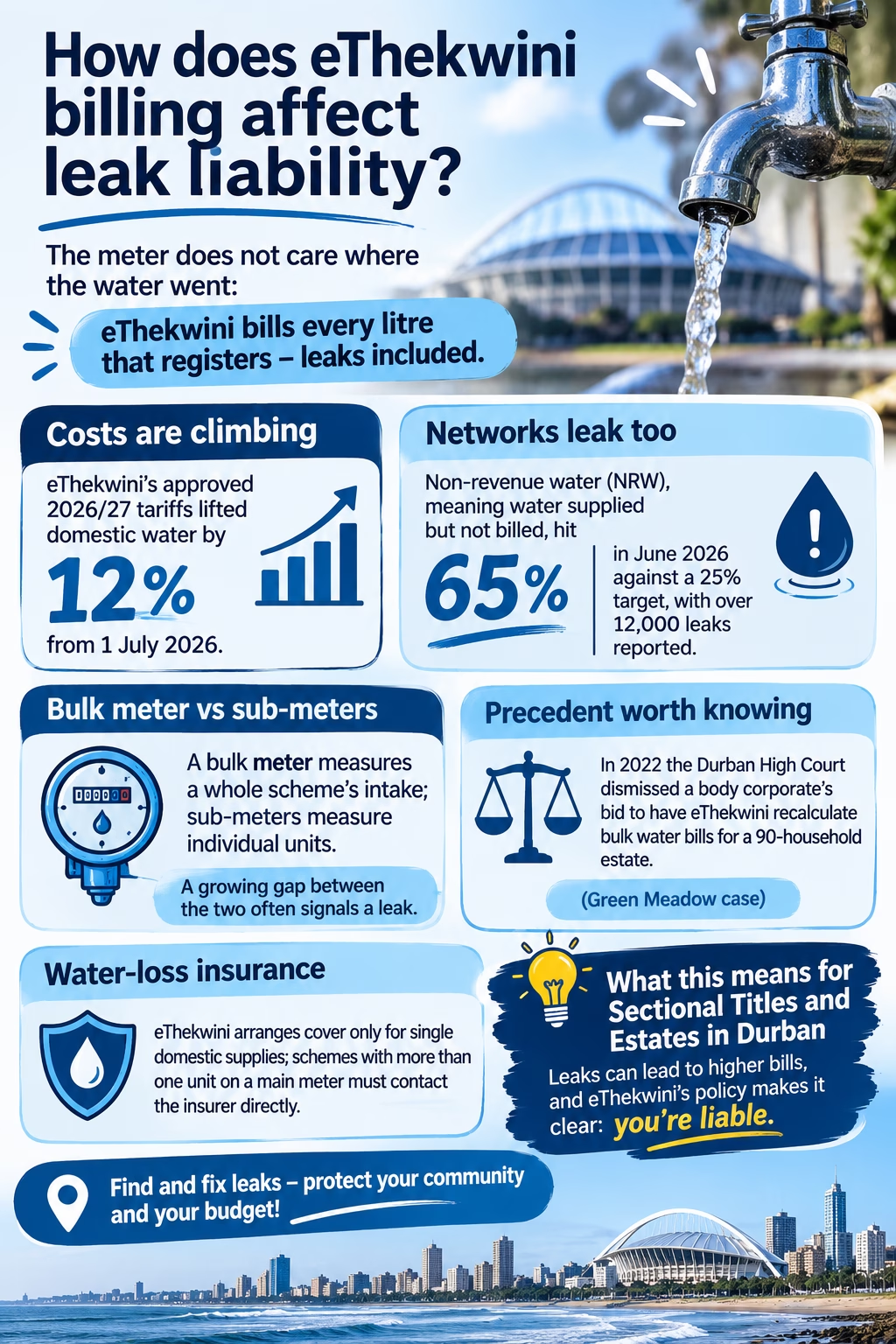
The meter does not care where the water went: eThekwini bills every litre that registers, leaks included.
- Costs are climbing: eThekwini's approved 2026/27 tariffs lifted domestic water by 12% from 1 July 2026.
- Networks leak too: non-revenue water (NRW), meaning water supplied but not billed, hit 65% in June 2026 against a 25% target, with over 12,000 leaks reported (TimesLive, DWS dashboard).
- Bulk meter vs sub-meters: a bulk meter measures a whole scheme's intake; sub-meters measure individual units. A growing gap between the two often signals a leak.
- Precedent worth knowing: in 2022 the Durban High Court dismissed a body corporate's bid to have eThekwini recalculate bulk water bills for a 90-household estate (Green Meadow case).
- Water-loss insurance: eThekwini arranges cover only for single domestic supplies; schemes with more than one unit on a main meter must contact the insurer directly.
The three-checkpoint test: a quick way to settle who pays
Leak disputes stall when nobody knows whose pipe it is. Walk the water through three checkpoints:
- Municipal meter: water that passed it is billed to the account holder, leak or not.
- Private sub-meter: anything downstream of it is normally the unit owner's cost and responsibility.
- Isolation valve: a leak beyond a unit's valve points to that unit; a leak before it points to the scheme.
How can trustees and HOAs reduce leak liability?
Prevention costs less than a surprise bill: inspect on schedule, log everything and insure the gaps.
- Fund the future: Prescribed Management Rule 22 requires sectional title schemes to keep a written 10-year maintenance, repair and replacement plan, so budget for pipe renewal before pipes fail. HOAs should mirror it.
- Respect the coast: salt air and humidity speed up corrosion on exposed pipes, valves and geysers, so inspect plant rooms, roof spaces and meter boxes quarterly.
- Fit smart tools: insta its important to inspect leak sensors or flow alarms at critical valves. eThekwini itself is rolling out digital leak-detection sensors
- Insure the gaps: Ask your broker whether the scheme policy covers water loss, gradual leaks and tracing costs, not just burst-pipe damage.
- Build to standard: national water regulations need consumer installations to comply with South African National Standard (SANS) 10252 for water supply installations in buildings.
Stop Guessing Where the Leak Is—And Who Pays for It.
Water damage in a Durban complex or estate escalates fast, and disputes over Body Corporate versus owner liability can stall urgent repairs. Don't let hidden leaks ruin your property or strain trustee budgets. Our Durban leak detection specialists provide non-invasive diagnostics and clear, insurance-ready reports so you know exactly where the problem is and who is responsible.

Andrew Jones
Master Plumber
Andrew Jones is a master plumber who has helped homeowners, sectional title schemes, estates and businesses across Durban find hidden leaks, repair them properly and keep water bills under control. His approach is simple: trace the real source quickly, fix it to standard, and document the work so trustees, owners and insurers have what they need.