Table of Contents
Key takeaways
- Spike vs. steady climb: A tariff increase lifts every bill by a similar percentage. A leak or an estimate shows up as a sudden jump in kl.
- The meter test: Switch off every tap, note your meter reading, wait an hour and read it again. A changed reading means water is escaping.
- Check the reading: An estimated reading can inflate a bill, so photograph your meter and compare it with your account
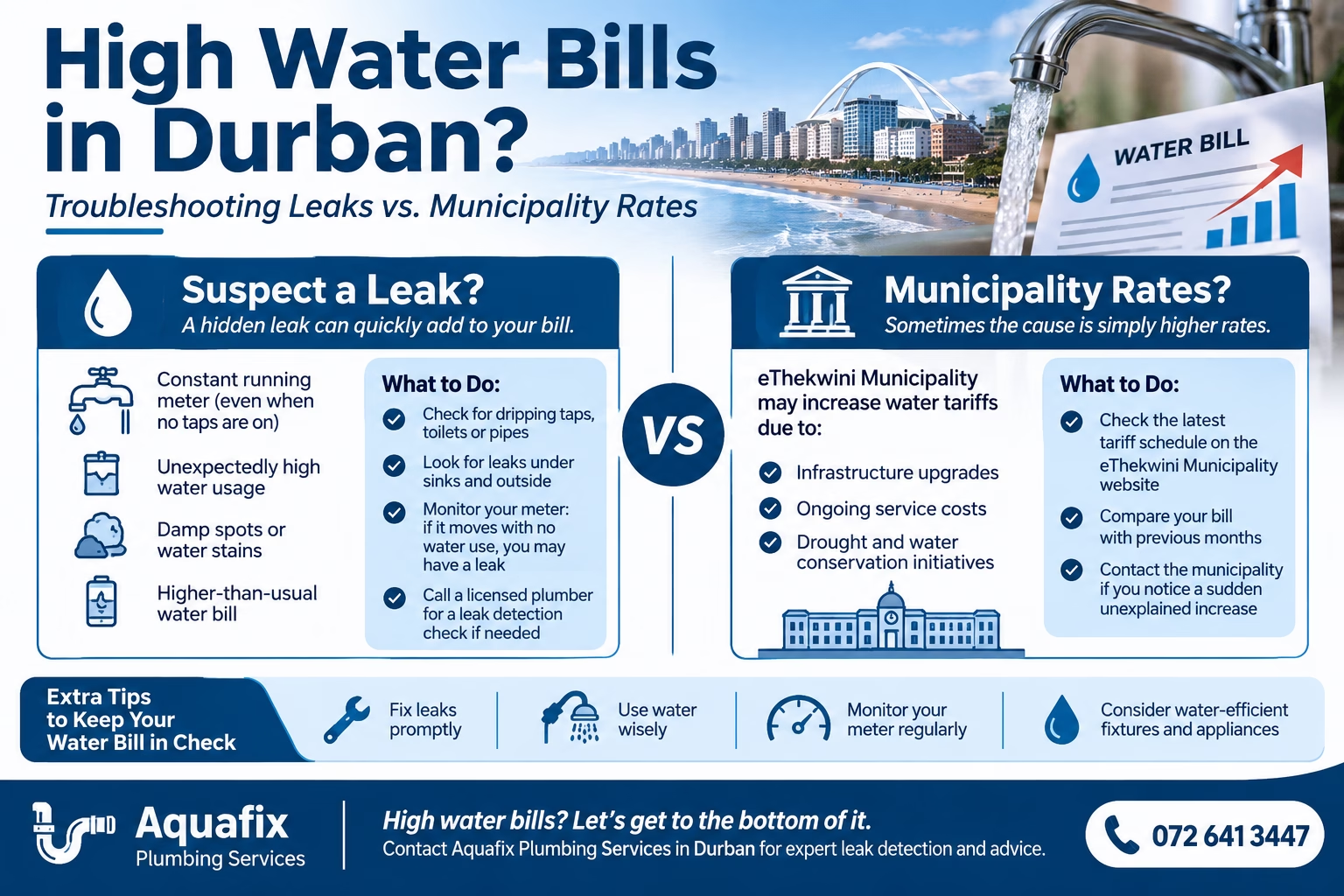
A high eThekwini water bill usually comes from one of four things: a hidden leak on your property, an estimated meter reading, the annual tariff increase, or a billing error. Domestic water tariffs rose 12% from 1 July 2026, but a sudden jump of thousands of rand almost always means extra kilolitres (kl, or 1,000 litres) rather than a higher rate per kl. If you've opened your municipal account in Durban and felt your stomach drop, you're not alone. Our blog shows you how to tell a leak from a rates increase in minutes, what to do about estimated readings, and how to lodge a dispute with the eThekwini Municipality the right way.
How does eThekwini calculate your water bill?
Your water charge is the kilolitres (kl) you use, priced on a stepped tariff, with sanitation and VAT billed alongside. Stepped means each extra kl costs more once you cross a threshold, so a leak that adds 10 kl lands in your most expensive bracket, not your cheapest.
The first 6 kl a month is free basic water for qualifying households. When the City found that homes valued above R250,000 had received it in error for years, it adjusted their bills. Around 49,000 households were affected by late 2023, so always read your line items.
2026/27 increases, effective 1 July 2026:
- Domestic water: +12% (trimmed from the 15% first proposed)
- Domestic sanitation: +8%
- Domestic refuse: +9.5%
- Property rates: +2%
Council approved these in May 2026 after cutting the draft increases.
Why do tariffs keep rising?
The City points to higher bulk charges from Eskom and uMngeni-uThukela Water, plus ageing, flood-damaged infrastructure. Meanwhile, non-revenue water (water supplied but never billed) is reportedly around 60%, driven by leaks and illegal use. Your tariff partly funds repairs on the City's side of the meter. The City says owners must repair leaks after the meter, while the municipality fixes leaks before
Is it a leak or a tariff increase?
A tariff increase lifts your bill by roughly the same percentage every month, while a leak or an estimate causes a sudden jump in kilolitres. A 12% increase turns a R1,000 water charge into about R1,120. If your bill has doubled, the tariff is not the culprit. Compare the kl figure on this month's account with the last six months, not the rand total. Flat kl with higher rands points to the tariff. Higher kl points to something else.
How do you query or dispute an eThekwini water bill?
You can submit Disputes, Complaints and Appeals Initiation form within 30 days of the account, attach your evidence, and keep paying the undisputed portion.
- Collect documents: the disputed account, your current bill, the owner's ID, proof of residence and evidence such as meter photos or a plumber's invoice.
- Name the amount. The form says a dispute must relate to a specific amount. A general query is not treated as a dispute.
- Submit the form at a customer service centre or to eThekwini Revenue, Florence Mkhize Building, 251 Anton Lembede Street, Durban (031 324 5000, revline@durban.gov.za).
- Pay the rest. Amounts not in dispute must be paid in full.
- Chase the outcome. The City aims to respond within 30 working days, and following up is your job
Can you get relief for a leak on your property?
Possibly. eThekwini has a water loss notification process for high bills caused by undetected leaks, and in March 2026 the City proposed a fixed monthly charge for all domestic water users to fund adjustments or write-offs in qualifying cases.
What the draft changes would mean:
- You would get 180 days from the date of repair (up from 60) to submit a water loss notification form with supporting documents at a Sizakala centre or Revenue Customer Services centre.
- The charge would apply to all people. According to the DA, customers with private plumbing insurance could previously opt out.
How do you keep your Durban water cost down?
Read your meter monthly and compare the kl with your bill, because the cheapest leak is the one you catch in week one.
- Read on a schedule. Log the same-day reading on your phone and submit it through eServices.
- Test toilets twice a year with food colouring, and replace worn flapper valves.
- Service irrigation timers and pool fillers before summer, and water gardens early morning or evening.
- Ask about a smart meter if you live in a rollout suburb such as Westville or uMhlanga.
Conclusion: check the kilolitres first
A water bills thats high is not a mystery once you separate rands from kilolitres. The 12% tariff increase explains a modest rise. A sudden jump in kl points to a leak, an estimate or a billing error. Run the meter test, photograph your reading, repair any leak with a registered plumber and keep every invoice. If the numbers still do not add up, lodge a written dispute, pay the undisputed portion and escalate step by step. Your next step: take a dated photo of your water meter today. It takes 30 seconds and could save you thousands of rand. WhatsApp us today for more information.Check the reading: An estimated reading can inflate a bill, so photograph your meter and compare it with your account. If you suspect a hidden leak, contact Durban water leak detection specialists for professional assistance.Check the reading: An estimated reading can inflate a bill, so photograph your meter and compare it with your account. If you suspect a hidden leak, contact Durban water leak detection specialists for professional assistance.
Meter fault vs hidden household leak: how to tell which is affecting your Durban water bill
Short answer: a hidden leak is the likely cause if your meter dial keeps moving while every tap is off. A meter fault or reading error is more likely if the dial stays still but your bill is high, jumps suddenly, or shows a reading that does not match your meter. Test first: read the meter, switch off all taps without flushing the toilet, wait 10 minutes, then read it again.
| What to check | Hidden household leak | Meter fault or reading error |
|---|---|---|
| 10-minute meter test with every tap off | The dial or leak indicator keeps moving. Water is passing through the meter with nothing in use, so the leak is on your side of the meter. Rule out refilling cisterns, tanks and irrigation first. | The dial stays still, so no water is passing through. A high bill then points to a reading, estimate or billing error. A very slow leak can still be missed, so repeat the check overnight. |
| Bill reading vs a dated photo of your meter | The reading on the bill matches your meter. The water was genuinely metered, so the question is where it went. | The bill reading is higher than your meter shows, or the meter number on the bill does not match the meter at your property. |
| Usage pattern over the last 6 to 12 bills | Consumption stays high month after month, or keeps climbing, until the leak is repaired. | One sudden spike, or a large catch-up charge after several estimated readings, while earlier and later months look normal. |
| Signs on your property and at the meter | Wet or unusually green patches on the ground, damp walls, the sound of running water, a toilet that keeps refilling, dripping taps or low water pressure. | No wet patches and no sound of running water. The meter face may be cracked, fogged or hard to read, which is worth reporting. |
| How the reading appears on your bill | The bill shows an actual reading and it agrees with your meter. | The bill shows an estimated reading or lists the meter as unread. eThekwini has said it estimates only in limited cases, and a later actual reading can cause a once-off adjustment. |
| Who fixes it and who pays | The property owner is responsible for leaks and repairs after the meter. Tenants should tell the landlord quickly. eThekwini Water and Sanitation handles leaks before the meter. | The municipality is responsible for the meter and its billing records. If a test finds the meter accurate and there is no leak, the usage is generally treated as real. Ask whether a test fee applies. |
| Your next step | Have a qualified plumber repair it, and keep the invoice and dated meter photos. Ask the city what leak relief or water-loss cover you may qualify for. Repair quickly so the bill stops growing. | Ask the city to test the meter and lodge a written dispute promptly. A 21-day dispute window has been cited under the city’s credit policy, so confirm your deadline. Do not tamper with the meter. |
How can I tell if my high Durban water bill is a leak or a meter fault?
Do the 10-minute test. Read the meter, turn off all taps without flushing, wait 10 minutes and read it again. If the reading changed, water is passing through the meter and you have a leak on your property. If it did not change, compare the bill reading with a dated photo of your meter and ask eThekwini to test the meter.
Who pays for a water leak on my property in Durban?
The property owner is responsible for leaks and repairs after the meter. eThekwini Water and Sanitation is responsible for leaks and repairs before the meter. If you rent, tell your landlord as soon as you find a leak.
How do I ask eThekwini to test my water meter?
Contact the Revline call centre on 031 324 5000 or revline@durban.gov.za, or visit your nearest Sizakala Centre. Lodge a dispute promptly and keep dated meter photos, plumber reports and your bills for reference.
Sources
- The Citizen (Berea Mail), 22 April 2025: steps to take with a high water bill
- The Citizen (Southlands Sun), 3 October 2024: leaks, meter checks and who is responsible
- eThekwini Municipality: press statement on billing accuracy
- Mail & Guardian, 27 January 2025: Durban ratepayer wins court battle over water bill