
Table of Contents
TL;DR
- A plumbing COC, issued only by a PIRB-registered plumber, is required before eThekwini and other KZN municipalities will approve a residential transfer.
- Sellers pay for the inspection, repairs, and certificate — typically R1,200 to R2,500, plus any repair costs found along the way.
- Geysers without compliant safety valves, drip trays, or vacuum breakers cause the most COC failures in KZN homes.
Everything a KwaZulu-Natal seller needs to inspect, fix, and document before a registered plumber can sign off — so transfer day comes around without a plumbing surprise.
If you're selling a home anywhere from Durban's beachfront to the Midlands, one document can quietly hold up thew sale of your property: the Plumbing Certificate of Compliance. Getting this sorted out early on , rather than scrambling at the last minute is the best way to keep your transfer moving as smoothly as possible.
What a Plumbing COC Actually Confirms
Why KZN Municipalities Enforce It So Strictly
KwaZulu-Natal's coastal humidity, hard water in parts of the Midlands, and ageing infrastructure in older Durban suburbs combine to put real strain on residential plumbing, which is why local authorities enforce the certificate so consistently.
- As a result, municipalities treat the COC as a frontline defence against contaminated water supply, sewage cross-connection, and wasted municipal water — all of which cost ratepayers directly.
- Legally, the requirement traces back to the National Building Regulations and Building Standards Act, together with each municipality's own water and sanitation bylaws.
- eThekwini's bylaws, for example , explicitly need a compliance certificate before a change of ownership is processed on the municipal account.
| Inspection point |
|---|
| 01Water Supply & Pressure |
| No visible leaks at any visible supply pipe, joint, or fitting |
| Correct pipe materials used throughout, with no mixed or incompatible fittings |
| Stopcocks and isolation valves present, accessible, and functioning |
| Water pressure within an acceptable, non-damaging range |
| 02Drainage & Sewage |
| Waste pipes correctly graded so water flows away without pooling |
| No cracked, blocked, or root-damaged sewer connections |
| Inspection eyes and manholes accessible and properly sealed |
| No cross-connection between stormwater and sewer lines |
| 03Hot Water & Geyser Safety |
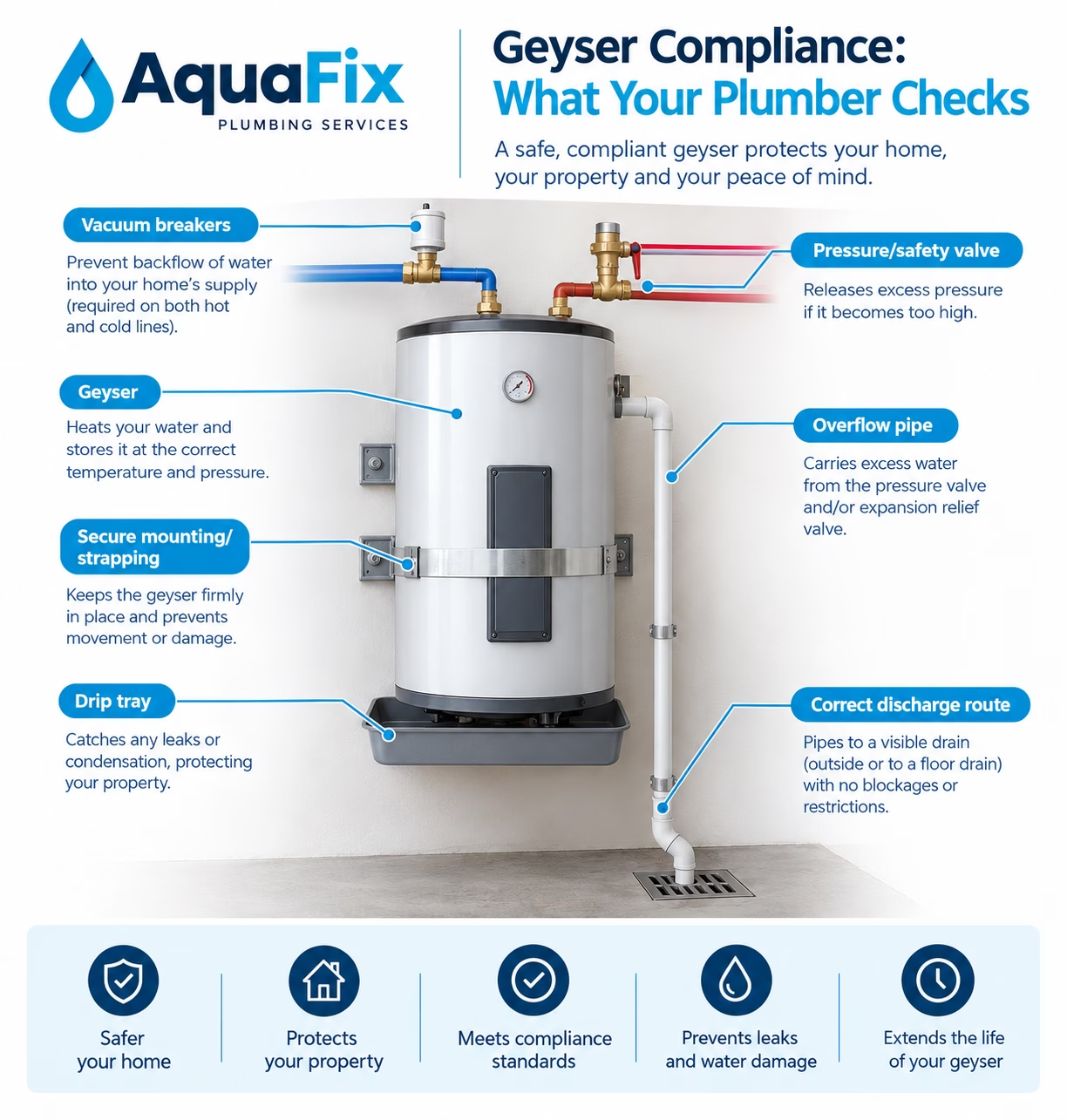
| Pressure control and safety (relief) valve fitted and functioning |
| Drip tray installed beneath the geyser, with a properly routed overflow pipe |
| Vacuum breakers fitted on both hot and cold lines |
| Geyser securely strapped and installed to manufacturer and SANS specification |
| 04Stormwater & Guttering |
| Gutters and downpipes directing water away from the foundation |
| No stormwater discharging into the sewer system |
| Paved or hardened surfaces graded to prevent pooling against walls |
| 05Fixtures, Fittings & Backflow |
| Taps, mixers, and toilet cisterns free of drips and running water |
| Backflow prevention fitted on outdoor taps and any irrigation connection |
| Pool and borehole plumbing, where present, isolated from the municipal supply |
| 06Documentation & Sign-Off |
| Inspecting plumber's PIRB registration number recorded on the certificate |
| Certificate copy supplied to your conveyancing attorney and the municipality |
| Any repair invoices retained as proof the defects were corrected before sign-off |
| Item | Typical range |
|---|---|
| Inspection & certificate | R1,200 – R2,500 |
| Common minor repairs | R500 – R3,000 |
| Geyser safety upgrade | R1,500 – R4,500 |
| Turnaround for certificate | 1 – 3 working days after repairs |
| Prices are indicative only and vary by property size, condition, and contractor. | |
Where Sellers Most Often Get Caught Out
- Geysers cause the single largest share of KZN compliance failures, mainly because older installations predate current safety-valve and drip-tray requirements.
- Beyond the geyser, inspectors most commonly flag exposed or incorrectly graded drainage pipework, missing backflow prevention on garden taps, and corrosion on ageing galvanised supply lines still common in Durban's older housing stock.
- Renovations are another frequent trap: if a previous owner added an en-suite, moved a kitchen sink, or installed irrigation without a compliant backflow valve, that work may never have been certified — This means it surfaces as a defect during your sale, even though you didn't cause it.
- For that reason, asking for your own COC when you originally purchased the property, if you don't already have one on file, can save considerable stress when it's your turn to sell.
Frequently asked questions
| Question | Answer |
|---|---|
| How to get a plumbing certificate of compliance? | In KwaZulu-Natal, you book a PIRB-registered plumber to inspect your property's water supply, drainage, hot water and stormwater installations against SANS 10252-1 and the National Building Regulations. Any defects, such as a geyser without a safety valve or drip tray, are repaired first. Once everything passes, the plumber issues the certificate, usually within 1 to 3 working days after repairs. Send a copy to your conveyancing attorney and the municipality. |
| How much does a plumbing compliance certificate cost? | A plumbing inspection and certificate typically costs R1,200 to R2,500 in KZN. Repairs are extra: common minor repairs run about R500 to R3,000, and a geyser safety upgrade about R1,500 to R4,500. These prices are indicative only and vary by property size, condition and contractor. The seller normally pays for the inspection, repairs and certificate. |
| Do you need a CoC for plumbing? | Yes, if you are selling a home in KwaZulu-Natal. eThekwini and other KZN municipalities require a plumbing certificate of compliance, issued by a PIRB-registered plumber, before they approve a residential transfer or process a change of ownership on the municipal account. Certificates are also commonly issued for certain new plumbing work, such as a geyser installation, so confirm with your plumber. |
| What are the safety rules for plumbers? | Only a PIRB-registered plumber can issue a compliance certificate, and all work must meet SANS 10252-1 and the National Building Regulations. On site, plumbers follow the Occupational Health and Safety Act: they wear suitable protective equipment, isolate water, electricity and gas before starting work, and take extra care when working at heights or in confined spaces. For hot water systems, the key requirements are a working pressure control and safety (relief) valve, a drip tray with a routed overflow pipe, vacuum breakers on the hot and cold lines, and a securely strapped geyser. |
Get in touch with us
Selling your home in KwaZulu-Natal is a massive milestone, but an outdated or non-compliant plumbing system can easily stall your sale at the finish line.