Key Takeaways - What is a tracer gas leak test and how does it work?
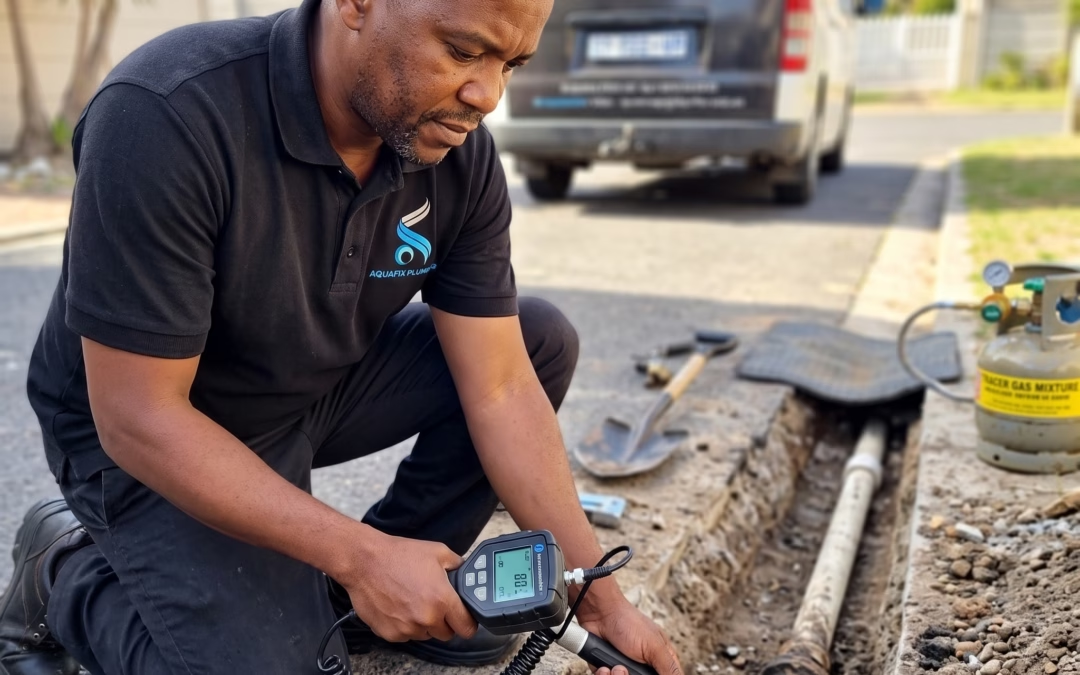
- A tracer gas leak test involves introducing into the pipe a harmless mixture of hydrogen and nitrogen and then using a sensitive detector to identify the exact point at which it escapes.
- It reaches through solid slabs, tiled floors, and walls and doesn't involve the need for guessing when digging or carrying out demolition.
- It is better than acoustic listening and thermal imaging when it comes to detecting small, deep, or cold-water leaks.
- The cost of an average residential test in Durban ranges from about R1,500 to R4,500, the amount depending on the length of the pipes and the ease of access.
Table of Contents
Silent leaks can undermine foundations and cause rot in Durban properties – long before they are detected. The eThekwini water network is already leaking heavily and property owners can no longer afford to guess. If you’re looking to find leaks without doing any damage, then a non-invasive, highly accurate method of doing this is tracer gas leak detection, and AquaFixes guide explains how it works, how it compares to other methods and why it’s so relevant in Durban right now.
How does it work?
- The gas blend: Typically 95% nitrogen, 5% hydrogen. Less dense than air with tiny enough molecules to slip thru cracks, hairline fractures and joint failures that water alone can’t reveal.
- The trail: Even the smallest leak points allow the gas to escape and rise up thru soil, tiles or concrete.
- The find: A technician walks the suspected area with a calibrated sensor, following the increasing concentration directly to the source.
Safety factor: At 5% commercial mixture the gas is chemically inert and non-flammable – no fire or health risk while the test is running.
Why Choose Tracer Gas Over Other Leak Detection Methods?
Durban's mixed housing stock, from beachfront apartment blocks to older homes with concrete slab foundations, means no single detection method suits every situation. Tracer gas holds a clear edge in the scenarios that frustrate homeowners most: leaks under tiles, leaks in cold-water lines, and leaks in high-noise commercial environments.
Is Tracer Gas Safe for My Home or Business?
Yes, tracer gas testing is safe for occupied homes, restaurants, guesthouses, and offices, provided a qualified technician handles the setup correctly. The hydrogen-nitrogen blend used commercially sits well below hydrogen's flammability threshold, and reputable plumbers ventilate the work area as a standard precaution regardless. Since the gas goes away quickly and doesn't leave any residue, companies that can't afford to be closed, can carry on operating as usual.
How Much Does a Tracer Gas Leak Test Cost in Durban?
How Do I Choose a Tracer Gas Leak Detection Company in Durban?
- Check IOPSA registration — membership with the Institute of Plumbing South Africa signals adherence to recognised trade standards.
- Ask about process — the technician should isolate and pressure-test the pipe section before injecting gas; skipping this step undermines accuracy.
- Request evidence — a written report with photographic or thermal proof of the leak location.
- Confirm insurance — the company should carry public liability cover in case access work causes incidental damage.
- Check response times — given Durban's current infrastructure strain, look for a company that can get to you within 24–48 hours, before a small leak becomes a structural problem.
Get Your Leak Found, Not Guessed At
A hidden leak rarely announces itself until the damage is already done, and in a city where the municipal network itself is losing nearly two-thirds of its treated water, private property owners carry more responsibility than ever for protecting their own pipework. If your water bill looks wrong, your floor feels warm in the wrong places, or your meter won't stop turning, get in touch with our team for a tracer gas leak test across Durban and the surrounding areas. We isolate the pipe, run the test, and hand you an exact location, so your repair is fast, targeted, and free of unnecessary demolition.
Tracer Gas Leak Test vs Helium Leak Detection: What's the Difference?
Both methods work the same basic way: a detectable gas is pressurised into a pipe or sealed system, escapes through any leak, and is picked up by a sensor. The difference is which gas is used, how sensitive the test is, and where each one is typically applied — in plumbing versus industrial settings.
Comparison at a Glance
| Factor | Tracer Gas Leak Test | Helium Leak Detection |
|---|---|---|
| Gas Used | A "forming gas" blend, usually 5% hydrogen / 95% nitrogen | Pure helium, or a helium-hydrogen mix |
| How It's Found | Gas is pumped into the pipe under pressure, escapes at the leak, and a handheld sniffer traces it on the surface | Same principle, but usually paired with a high-precision sniffer or a mass spectrometer for lab-grade readings |
| Sensitivity | Very good for pinpointing typical underground water, pool and drain leaks | Extremely high — can detect micro-leaks far smaller than a plumbing sniffer needs to find |
| Typical Use | Underground water pipes, slab leaks, pool plumbing, drainage — standard residential/commercial leak detection | Sealed refrigeration/HVAC units, manufacturing QC, aerospace and vacuum systems |
| Equipment Cost | Lower — more affordable sniffer equipment, common with local leak detection specialists | Higher — helium is scarcer and mass spectrometer units are a significant investment |
| Safety | Non-flammable at 5% concentration, non-toxic, safe for potable water lines | Inert, non-flammable, non-toxic |
| In residential and commercial plumbing, "tracer gas leak test" almost always means the hydrogen/nitrogen method — helium leak detection is generally reserved for industrial and manufacturing sealed-system testing. | ||
Which Method Should You Choose?
For a household or commercial water leak — under a slab, in a pool line, or underground — a standard tracer gas (hydrogen/nitrogen) test from a qualified leak detection specialist is the practical, cost-effective choice. Helium leak detection only becomes relevant if you're testing a sealed manufactured component or an industrial system that needs micro-leak precision.
Further Reading
For more on how tracer gas and other non-invasive methods are used to find leaks in South Africa, see HydroTrace — Leak Detection & Infrastructure Diagnostics Specialists, which covers tracer gas, acoustic and thermal detection across Gauteng, the Western Cape and KwaZulu-Natal.