Table of Contents
The Ultimate Guide for Durban Homeowners and Businesses
Maintaining your property's waste systems can feel overwhelming, but understanding your options shouldn't be. When dealing with underground piping issues, homeowners often face a choice between traditional digging and modern, non-invasive methods. Navigating these choices requires balancing local environmental challenges with the right solutions. To ensure your repairs comply with local standards, it is always best to review the guidelines set out by the eThekwini Municipality Environmental Health and Sanitation Bylaws.
At Aquafix Plumbing Services, we believe in transparent, long-lasting drainage solutions for Durban homes. Our blog breaks down why underground lines fail and how we restore them with minimal disruption to your daily service.
Key Takeaways
-
Primary Failure Modes: Root intrusion is a major problem while shifting sand destabilises lines in Umhlanga, and expanding clay damages joints in Durban North.
-
Trenchless Pipe Relining: This method eliminates the need for digging by creating a permanent, epoxy-based structural pipe within the damaged host line.
-
High-Pressure Hydro-Jetting: Using water pressures up to 4,000 PSI, this method clears hardened fats, heavy scale, and root mass obstructions.
-
Bio-Remediation: Introducing specialized bacterial cultures dissolves restrictive organic buildup in soil absorption fields without disturbing the surrounding ecosystem.
-
Traditional Open-Trench Excavation: Severe structural collapses or misaligned pipe gradients require physical replacement using heavy-duty, 50-year-lifespan High-Density Polyethylene (HDPE) conduits.
How can I tell if my septic line is failing?
You don't need to see beneath the ground to know your drainage system is struggling. Underground piping failure typically manifests through several distinct warning signs on your property:
-
Sluggish Drainage: If sinks, showers, and toilets across your home are slow to clear, the bottleneck is likely deep within your main line rather than a single fixture.
-
Lush, Isolated Green Patches: A sudden, unusually vibrant patch of grass in your garden often indicates that a cracked pipe is leaking nutrient-rich wastewater into the surrounding soil.
-
Persistent Odors: The unmistakable smell of sewer gas around your yard or ground-floor drains is a clear indicator of a breach in the pipeline.
-
Sinking Ground: Soil indentation or pooling water above the path of your septic line suggests that escaping water is actively washing away the soil underneath.
How Do Tree Roots Invade Subsurface Infrastructure?
In older, established neighborhoods like Westville, properties feature mature tree canopies and dense vegetation. Indigenous tree species possess expansive lateral root networks that actively seek out sources of moisture and nutrients. Small seasonal cracks or weakened joints in older earthenware or standard PVC septic lines release moisture vapor into the surrounding soil.
Roots detect these small traces, and follow them back to the source pipe. Once a single root strand penetrates a compromised joint, the nutrient-rich wastewater accelerates its growth. This internal expansion forms a dense root mass that completely blocks hydraulic flow and splits the pipe walls apart over time.
How Do Shifting Coastal Soils Cause Pipeline Structural Failure?
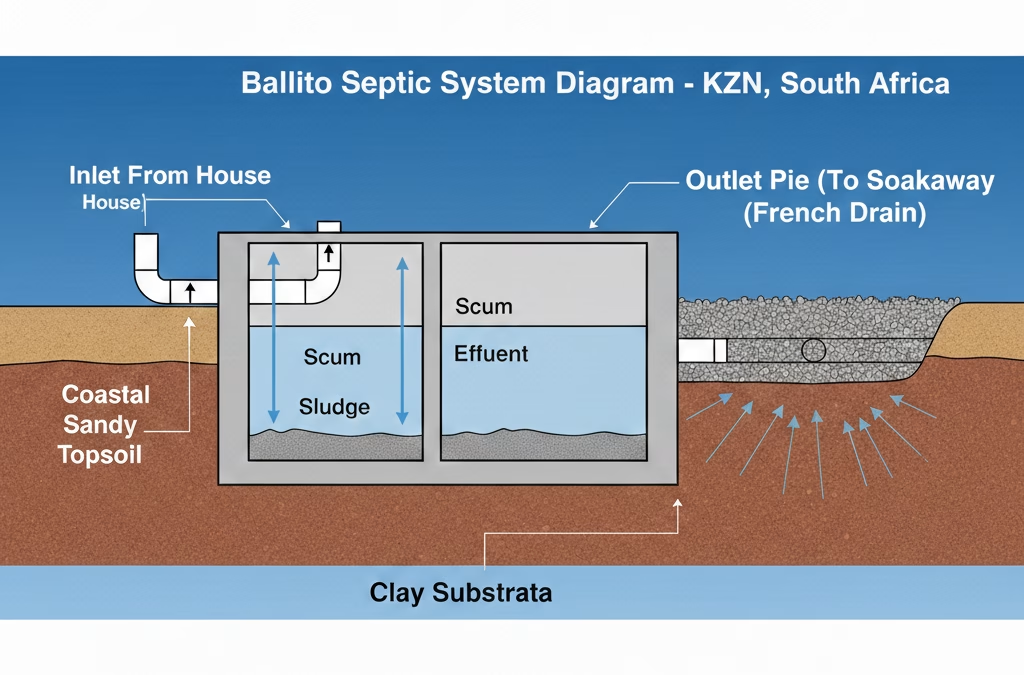
The structural integrity of underground piping relies entirely on the stability of the surrounding earth. In coastal areas like Umhlanga, the soil is predominantly loose and sandy. This loose composition provides very little natural structural support, leaving pipes highly susceptible to shifting, bowing, and joint separation under the weight of the earth above.
Conversely, areas like Durban North are characterised by heavy, expansive clay soils. This type of earth acts similarly to a sponge, experiencing immense mechanical stress as it dramatically swells during wet periods and shrinks during dry spells.
This cyclical movement is exacerbated by Durban's intense subtropical climate, where peak summer rainfall regularly averages around 130mm per month. The resulting shifting forces can easily snap rigid, aging pipes. Because underground damage escalates quickly, it is vital to know how to identify the early signs of septic tank collapse before a total structural failure ruins your property.
Signs of Septic Line Failure
Recognizing subsurface plumbing degradation early prevents costly emergency repairs and minimizes property contamination. Property owners should monitor their land for the following indicators:
-
Persistent gurgling sounds originating from plumbing fixtures or ground-level inspection eyes.
-
Unusually lush, dark green patches of grass forming over known drainage pathways.
-
Slow-draining sinks, showers, and toilets that do not respond to standard mechanical plunging.
-
Soggy, waterlogged soil zones or localized pooling accompanied by distinct sewage odors.
-
Sudden, unexplained structural cracking in boundary walls or paved driveways situated near subsurface lines.
How Does Trenchless Pipe Relining Work?
Trenchless pipe relining gives people a non-invasive alternative to traditional excavation. This specialised methodology repairs damaged infrastructure from the inside out, preserving driveways, flooring, and gardens. Property owners often reference this process as Cured-in-place pipe (CIPP) technology.
The Liner Insertion Process
Technicians start the repair by accessing the damaged septic line through an existing inspection eye or manhole. After clearing the pipe, our operators use a pneumatic inversion drum to insert a flexible, fiberglass-reinforced textile liner into the run. This liner undergoes complete saturation with a structural, ambient-cure epoxy resin prior to deployment.
Compressed air forces the flexible liner to invert through the interior of the fractured pipe, turning it inside out. This directional force presses the resin-covered surface directly against the defective internal walls of the host pipe, driving the structural adhesive into every crack, hole, and separated joint.
The Curing and Finishing Process
Once fully developed the liner remains pressurised to maintain its exact cylindrical shape against the inner walls of the old pipe. The specialized epoxy resin initiates a chemical exothermic reaction, transforming from a liquid state into a solid, premium-grade structural sleeve.
After about three to four hours, technicians vent the air pressure and trim the ends of the newly formed pipe. This process creates a continuous, jointless fluid channel within the old 110mm or 160mm infrastructure. The completed installation seals out future root growth and restores original flow rates.
When Is Traditional Open-Trench Excavation Unavoidable?
Despite the clear benefits of trenchless alternatives, certain structural failures require traditional open-trench excavation. Understanding when to use this method ensures structural safety and compliance with building codes.
- When a subsurface pipe suffers a complete structural collapse, the surrounding soil caves into the line, completely blocking the path. Because the original pathway no longer exists, technicians cannot insert a trenchless liner.
- Additionally, if a pipeline develops a severe physical sag or "belly" due to major soil shifting, trenchless relining cannot correct the grade. The new liner would simply mirror the existing sag, failing to resolve the underlying standing-water problem.
- Traditional excavation requires using mechanical diggers or manual labor to uncover the damaged pipe section safely. Technicians remove the broken earthenware or degraded PVC and rebuild the structural foundation using compacted aggregate stone.
Our team then installs premium High-Density Polyethylene (HDPE) or heavy-wall class-16 PVC piping. HDPE components provide very good impact resistance and last for about fifty years, successfully withstanding future ground shifting.
Sewer Line Rehabilitation Methods
Trenchless Pipe Relining
High-Pressure Hydro-Jetting
Bio-Remediation
Traditional Excavation

Durban Case Studies: Practical Field Applications
To demonstrate how these methods function in real-world scenarios, review these recent interventions executed by Squafix Plumbing Services across the eThekwini region.
Resolving Root Intrusion in a Westville Residential Estate
A homeowner in Westville experienced reoccurring drainage backups. Our team deployed a high-resolution, waterproof sewer inspection camera to examine the 110mm main drainage line. The video feed revealed that roots from a nearby Natal Fig had broken through two consecutive pipe joints, capturing solid waste and blocking flow.
Clearing Commercial Grease Accumulations in Umhlanga
A busy, restaurant in Umhlanga faced an emergency plumbing crisis when wastewater began backing up into the ground-floor kitchens. Our emergency crew arrived and identified a severe accumulation of Fats, Oils, and Grease (FOG) inside the primary 160mm outflow line connecting to their localised containment system.